Page 24 - Utah Science Textbook
P. 24
States of Matter
Introduction
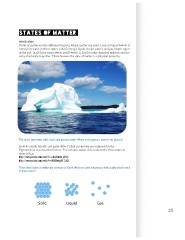
States of matter are the different forms in which matter can exist. Look at Figure below. It
represents water in three states: solid (iceberg), liquid (ocean water), and gas (water vapor
in the air). In all three states, water is still water. It has the same chemical makeup and the
same chemical properties. That’s because the state of matter is a physical property.
This photo represents solid, liquid, and gaseous water. Where is the gaseous water in the picture?
How do solids, liquids, and gases differ? Their properties are compared in the
Figure below and described below. You can also watch videos about the three states at
these URLs:
http://www.youtube.com/watch?v=s-KvoVzukHo (0:52)
http://www.youtube.com/watch?v=NO9OGeHgtBY (1:42)
These three states of matter are common on Earth. What are some substances that usually exist in each
of these states?
25
Introduction
States of matter are the different forms in which matter can exist. Look at Figure below. It
represents water in three states: solid (iceberg), liquid (ocean water), and gas (water vapor
in the air). In all three states, water is still water. It has the same chemical makeup and the
same chemical properties. That’s because the state of matter is a physical property.
This photo represents solid, liquid, and gaseous water. Where is the gaseous water in the picture?
How do solids, liquids, and gases differ? Their properties are compared in the
Figure below and described below. You can also watch videos about the three states at
these URLs:
http://www.youtube.com/watch?v=s-KvoVzukHo (0:52)
http://www.youtube.com/watch?v=NO9OGeHgtBY (1:42)
These three states of matter are common on Earth. What are some substances that usually exist in each
of these states?
25