Page 28 - Utah Science Textbook
P. 28
Standard 1:
students will understand the
structure of matter
Objective 2:
You will be able to accurately measure the characteristics of matter in different states
Introduction Terms to Know:
Here’s a riddle for you to ponder: What do you and a tiny speck of dust in outer space o Matter
have in common? Think you know the answer? Read on to find out.
What is Matter? o Mass
Both you and the speck of dust consist of atoms of matter. So does the ground beneath
your feet. In fact, everything you can see and touch is made of matter. The only things o Volume
that aren’t matter are forms of energy, such as light and sound. Although forms of energy
are not matter, the air and other substances they travel through are. So what is o Density
matter? Matter is defined as anything that has mass and volume.
o Solid
Mass
Mass is the amount of matter in a substance or object. Mass is commonly measured with a o Liquid
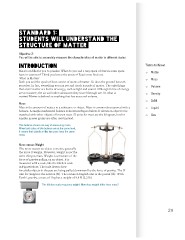
balance. A simple mechanical balance is shown in Figure below. It allows an object to be
matched with other objects of known mass. SI units for mass are the kilogram, but for o Gas
smaller masses grams are often used instead.
This balance shows one way of measuring mass.
When both sides of the balance are at the same level,
it means that objects in the two pans have the same
mass.
Mass versus Weight
The more matter an object contains, generally
the more it weighs. However, weight is not the
same thing as mass. Weight is a measure of the
force of gravity pulling on an object. It is
measured with a scale, like the kitchen scale
in Figure below. The scale detects how
forcefully objects in the pan are being pulled downward by the force of gravity. The SI
unit for weight is the newton (N). The common English unit is the pound (lb). With
Earth’s gravity, a mass of 1 kg has a weight of 9.8 N (2.2 lb).
This kitchen scale measures weight. How does weight differ from mass?
29
students will understand the
structure of matter
Objective 2:
You will be able to accurately measure the characteristics of matter in different states
Introduction Terms to Know:
Here’s a riddle for you to ponder: What do you and a tiny speck of dust in outer space o Matter
have in common? Think you know the answer? Read on to find out.
What is Matter? o Mass
Both you and the speck of dust consist of atoms of matter. So does the ground beneath
your feet. In fact, everything you can see and touch is made of matter. The only things o Volume
that aren’t matter are forms of energy, such as light and sound. Although forms of energy
are not matter, the air and other substances they travel through are. So what is o Density
matter? Matter is defined as anything that has mass and volume.
o Solid
Mass
Mass is the amount of matter in a substance or object. Mass is commonly measured with a o Liquid
balance. A simple mechanical balance is shown in Figure below. It allows an object to be
matched with other objects of known mass. SI units for mass are the kilogram, but for o Gas
smaller masses grams are often used instead.
This balance shows one way of measuring mass.
When both sides of the balance are at the same level,
it means that objects in the two pans have the same
mass.
Mass versus Weight
The more matter an object contains, generally
the more it weighs. However, weight is not the
same thing as mass. Weight is a measure of the
force of gravity pulling on an object. It is
measured with a scale, like the kitchen scale
in Figure below. The scale detects how
forcefully objects in the pan are being pulled downward by the force of gravity. The SI
unit for weight is the newton (N). The common English unit is the pound (lb). With
Earth’s gravity, a mass of 1 kg has a weight of 9.8 N (2.2 lb).
This kitchen scale measures weight. How does weight differ from mass?
29