Page 29 - Utah Science Textbook
P. 29
Problem Solving
Problem: At Earth’s gravity, what is the weight in newtons
of an object with a mass of 10 kg?
Solution: At Earth’s gravity, 1 kg has a weight of 9.8 N.
Therefore, 10 kg has a weight of (10 × 9.8 N) = 98 N.
You Try It!
Problem: If you have a mass of 50 kg on Earth, what is your weight in newtons?
An object with more mass is pulled by gravity with greater force, so mass and weight are
closely related. However, the weight of an object can change if the force of gravity
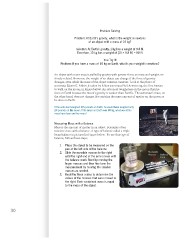
changes, even while the mass of the object remains constant. Look at the photo of
astronaut Edwin E. Aldrin Jr taken by fellow astronaut Neil Armstrong, the first human
to walk on the moon, in Figure below. An astronaut weighs less on the moon than he
does on Earth because the moon’s gravity is weaker than Earth’s. The astronaut’s mass, on
the other hand, does not change. He contains the same amount of matter on the moon as
he does on Earth.
If the astronaut weighed 175 pounds on Earth, he would have weighed only
29 pounds on the moon. If his mass on Earth was 80 kg, what would his
mass have been on the moon?
Measuring Mass with a Balance
Mass is the amount of matter in an object. Scientists often
measure mass with a balance. A type of balance called a triple
beam balance is pictured in Figure below. To use this type of
balance, follow these steps:
1. Place the object to be measured on the
pan at the left side of the balance.
2. Slide the movable masses to the right
until the right end of the arm is level with
the balance mark. Start by moving the
larger masses and then fine tune the
measurement by moving the smaller
masses as needed.
3. Read the three scales to determine the
values of the masses that were moved to
the right. Their combined mass is equal
to the mass of the object.
30
Problem: At Earth’s gravity, what is the weight in newtons
of an object with a mass of 10 kg?
Solution: At Earth’s gravity, 1 kg has a weight of 9.8 N.
Therefore, 10 kg has a weight of (10 × 9.8 N) = 98 N.
You Try It!
Problem: If you have a mass of 50 kg on Earth, what is your weight in newtons?
An object with more mass is pulled by gravity with greater force, so mass and weight are
closely related. However, the weight of an object can change if the force of gravity
changes, even while the mass of the object remains constant. Look at the photo of
astronaut Edwin E. Aldrin Jr taken by fellow astronaut Neil Armstrong, the first human
to walk on the moon, in Figure below. An astronaut weighs less on the moon than he
does on Earth because the moon’s gravity is weaker than Earth’s. The astronaut’s mass, on
the other hand, does not change. He contains the same amount of matter on the moon as
he does on Earth.
If the astronaut weighed 175 pounds on Earth, he would have weighed only
29 pounds on the moon. If his mass on Earth was 80 kg, what would his
mass have been on the moon?
Measuring Mass with a Balance
Mass is the amount of matter in an object. Scientists often
measure mass with a balance. A type of balance called a triple
beam balance is pictured in Figure below. To use this type of
balance, follow these steps:
1. Place the object to be measured on the
pan at the left side of the balance.
2. Slide the movable masses to the right
until the right end of the arm is level with
the balance mark. Start by moving the
larger masses and then fine tune the
measurement by moving the smaller
masses as needed.
3. Read the three scales to determine the
values of the masses that were moved to
the right. Their combined mass is equal
to the mass of the object.
30