Page 22 - Utah Science Textbook
P. 22
Electron Cloud
In the 1920s, physicists discovered that electrons do not travel in fixed paths. In fact, they
found that electrons only have a certain chance of being in any particular place. They
could only describe where electrons are with mathematical formulas. That’s because
electrons have wave-like properties as well as properties of particles of matter. It is the
"wave nature" of electrons that lets them exist only at certain distances from the nucleus.
The negative electrons are attracted to the positive nucleus. However, because the
electrons behave like waves, they bend around the nucleus instead of falling toward it.
Electrons exist only where the wave is stable. These are the orbitals. They do not exist
where the wave is not stable. These are the places between orbitals.
Electron Cloud Model
Today, these ideas about electrons are represented by the electron cloud model.
The electron cloud is an area around the nucleus where electrons are likely to
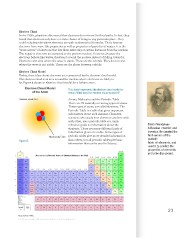
be. Figure 8 shows an electron cloud model for a helium atom.
This sketch represents the electron cloud model for
helium. What does the electron cloud represent?
Atoms, Molecules and the Periodic Table
There are 92 naturally occurring types of atoms.
These types of atoms are called elements. The
Periodic Table is a table that gives important
information about each element. Chemists,
scientists who study how elements combine with
each other, use a periodic table as a quick
reference guide to information about the Dmitri Mendeleev
elements. There are many different kinds of A Russian chemist and
information given on a table. Some types of inventor. He created the
periodic tables give more detailed information first version of the
Figure 8. than others, but all periodic tables give basic periodic
information that can be used in Science. table of elements, and
used it to predict the
properties of elements
yet to be discovered.
23
Image by Ivan Griffin,
http://www.texample.net/tikz/examples/periodic-table-of-chemical-elements/
In the 1920s, physicists discovered that electrons do not travel in fixed paths. In fact, they
found that electrons only have a certain chance of being in any particular place. They
could only describe where electrons are with mathematical formulas. That’s because
electrons have wave-like properties as well as properties of particles of matter. It is the
"wave nature" of electrons that lets them exist only at certain distances from the nucleus.
The negative electrons are attracted to the positive nucleus. However, because the
electrons behave like waves, they bend around the nucleus instead of falling toward it.
Electrons exist only where the wave is stable. These are the orbitals. They do not exist
where the wave is not stable. These are the places between orbitals.
Electron Cloud Model
Today, these ideas about electrons are represented by the electron cloud model.
The electron cloud is an area around the nucleus where electrons are likely to
be. Figure 8 shows an electron cloud model for a helium atom.
This sketch represents the electron cloud model for
helium. What does the electron cloud represent?
Atoms, Molecules and the Periodic Table
There are 92 naturally occurring types of atoms.
These types of atoms are called elements. The
Periodic Table is a table that gives important
information about each element. Chemists,
scientists who study how elements combine with
each other, use a periodic table as a quick
reference guide to information about the Dmitri Mendeleev
elements. There are many different kinds of A Russian chemist and
information given on a table. Some types of inventor. He created the
periodic tables give more detailed information first version of the
Figure 8. than others, but all periodic tables give basic periodic
information that can be used in Science. table of elements, and
used it to predict the
properties of elements
yet to be discovered.
23
Image by Ivan Griffin,
http://www.texample.net/tikz/examples/periodic-table-of-chemical-elements/