Page 21 - Utah Science Textbook
P. 21
Bohr's Model of the Atom
Bohr’s research focused on electrons. In 1913, he discovered evidence that the orbits of
electrons are located at fixed distances from the nucleus. Remember, Rutherford thought
that electrons orbit the nucleus at random. Bohr's model of the atom.
Energy Levels
Basic to Bohr’s model is the idea of energy levels. Energy
levels are areas located at fixed distances from the nucleus of the
atom. They are the only places where electrons can be found.
Energy levels are a little like rungs on a ladder. You can stand on
one rung or another but not between the rungs. The same goes
for electrons. They can occupy one energy level or another but
not the space between energy levels.
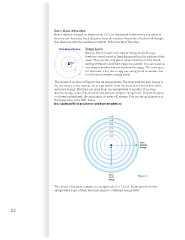
The model of an atom in Figure 7 has six energy levels. The level with the least energy is
the one closest to the nucleus. As you go farther from the nucleus, the levels have more
and more energy. Electrons can jump from one energy level to another. If an atom
absorbs energy, some of its electrons can jump to a higher energy level. If electrons jump
to a lower energy level, the atom emits, or gives off, energy. You can see an animation at
this happening at the URL below.
http://cas.sdss.org/dr6/en/proj/advanced/spectraltypes/energylevels.asp
Figure 7.
This model of an atom contains six energy levels (n = 1 to 6). Atoms absorb or emit
energy when some of their electrons jump to a different energy level.
22
Bohr’s research focused on electrons. In 1913, he discovered evidence that the orbits of
electrons are located at fixed distances from the nucleus. Remember, Rutherford thought
that electrons orbit the nucleus at random. Bohr's model of the atom.
Energy Levels
Basic to Bohr’s model is the idea of energy levels. Energy
levels are areas located at fixed distances from the nucleus of the
atom. They are the only places where electrons can be found.
Energy levels are a little like rungs on a ladder. You can stand on
one rung or another but not between the rungs. The same goes
for electrons. They can occupy one energy level or another but
not the space between energy levels.
The model of an atom in Figure 7 has six energy levels. The level with the least energy is
the one closest to the nucleus. As you go farther from the nucleus, the levels have more
and more energy. Electrons can jump from one energy level to another. If an atom
absorbs energy, some of its electrons can jump to a higher energy level. If electrons jump
to a lower energy level, the atom emits, or gives off, energy. You can see an animation at
this happening at the URL below.
http://cas.sdss.org/dr6/en/proj/advanced/spectraltypes/energylevels.asp
Figure 7.
This model of an atom contains six energy levels (n = 1 to 6). Atoms absorb or emit
energy when some of their electrons jump to a different energy level.
22