Page 18 - Utah Science Textbook
P. 18
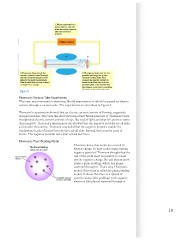
Figure 5.
Thomson's Vacuum Tube Experiments
Thomson was interested in electricity. He did experiments in which he passed an electric
current through a vacuum tube. The experiments are described in Figure 5.
Thomson’s experiments showed that an electric current consists of flowing, negatively
charged particles. Why was this discovery important? Many scientists of Thomson’s time
thought that electric current consists of rays, like rays of light, and that it is positive rather
than negative. Thomson’s experiments also showed that the negative particles are all alike
and smaller than atoms. Thomson concluded that the negative particles couldn’t be
fundamental units of matter because they are all alike. Instead, they must be parts of
atoms. The negative particles were later named electrons.
Thomson's Plum Pudding Model
Thomson knew that atoms are neutral in
electric charge. So how could atoms contain
negative particles? Thomson thought that the
rest of the atom must be positive to cancel
out the negative charge. He said that an atom
is like a plum pudding, which has plums
scattered through it. That’s why Thomson’s
model of the atom is called the plum pudding
model. It shows the atom as a sphere of
positive charge (the pudding) with negative
electrons (the plums) scattered through it.
19
Thomson's Vacuum Tube Experiments
Thomson was interested in electricity. He did experiments in which he passed an electric
current through a vacuum tube. The experiments are described in Figure 5.
Thomson’s experiments showed that an electric current consists of flowing, negatively
charged particles. Why was this discovery important? Many scientists of Thomson’s time
thought that electric current consists of rays, like rays of light, and that it is positive rather
than negative. Thomson’s experiments also showed that the negative particles are all alike
and smaller than atoms. Thomson concluded that the negative particles couldn’t be
fundamental units of matter because they are all alike. Instead, they must be parts of
atoms. The negative particles were later named electrons.
Thomson's Plum Pudding Model
Thomson knew that atoms are neutral in
electric charge. So how could atoms contain
negative particles? Thomson thought that the
rest of the atom must be positive to cancel
out the negative charge. He said that an atom
is like a plum pudding, which has plums
scattered through it. That’s why Thomson’s
model of the atom is called the plum pudding
model. It shows the atom as a sphere of
positive charge (the pudding) with negative
electrons (the plums) scattered through it.
19