Page 17 - Utah Science Textbook
P. 17
Dalton's Atomic Theory
The atomic theory Dalton developed consists of three ideas:
All substances are made of atoms. Atoms are the smallest particles of matter. They cannot
be divided into smaller particles. They also cannot be created or destroyed.
All atoms of the same element are alike and have the same mass. Atoms of different
elements are different and have different masses.
Atoms join together to form compounds. A given compound always consists of the same
kinds of atoms in the same ratio.
Dalton’s theory was soon widely accepted. Most of it is still accepted today. The only part
that is no longer accepted is his idea that atoms are the smallest particles. Scientists now
know that atoms consist of even smaller particles.
Dalton's Atomic Models
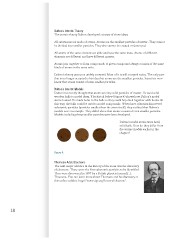
Dalton incorrectly thought that atoms are tiny solid particles of matter. He used solid
wooden balls to model them. The sketch below (Figure 4) shows how Dalton’s model
atoms looked. He made holes in the balls so they could be joined together with hooks. In
this way, the balls could be used to model compounds. When later scientists discovered
subatomic particles (particles smaller than the atom itself), they realized that Dalton’s
models were too simple. They didn’t show that atoms consist of even smaller particles.
Models including these smaller particles were later developed.
Dalton’s model atoms were hard,
solid balls. How do they differ from
the atomic models earlier in the
chapter?
Figure 4.
Thomson Adds Electrons
The next major advance in the history of the atom was the discovery
of electrons. These were the first subatomic particles to be identified.
They were discovered in 1897 by a British physicist named J. J.
Thomson. You can learn more about Thomson and his discovery at
this online exhibit: http://www.aip.org/history/electron/.
18
The atomic theory Dalton developed consists of three ideas:
All substances are made of atoms. Atoms are the smallest particles of matter. They cannot
be divided into smaller particles. They also cannot be created or destroyed.
All atoms of the same element are alike and have the same mass. Atoms of different
elements are different and have different masses.
Atoms join together to form compounds. A given compound always consists of the same
kinds of atoms in the same ratio.
Dalton’s theory was soon widely accepted. Most of it is still accepted today. The only part
that is no longer accepted is his idea that atoms are the smallest particles. Scientists now
know that atoms consist of even smaller particles.
Dalton's Atomic Models
Dalton incorrectly thought that atoms are tiny solid particles of matter. He used solid
wooden balls to model them. The sketch below (Figure 4) shows how Dalton’s model
atoms looked. He made holes in the balls so they could be joined together with hooks. In
this way, the balls could be used to model compounds. When later scientists discovered
subatomic particles (particles smaller than the atom itself), they realized that Dalton’s
models were too simple. They didn’t show that atoms consist of even smaller particles.
Models including these smaller particles were later developed.
Dalton’s model atoms were hard,
solid balls. How do they differ from
the atomic models earlier in the
chapter?
Figure 4.
Thomson Adds Electrons
The next major advance in the history of the atom was the discovery
of electrons. These were the first subatomic particles to be identified.
They were discovered in 1897 by a British physicist named J. J.
Thomson. You can learn more about Thomson and his discovery at
this online exhibit: http://www.aip.org/history/electron/.
18