Page 15 - Utah Science Textbook
P. 15
Sizes of Atoms
The graphite in your pencil is composed of the element carbon. Imagine taking a small
piece of carbon and grinding it until it is a fine dust. Each speck of carbon would still have
all of the physical and chemical properties of the carbon atom. Now imagine that you
could somehow keep dividing the speck of carbon into smaller and smaller pieces.
Eventually, you would reach a point where your carbon sample is as small as it could
possibly be. This final particle is called an atom, which is defined as the smallest particle of
an element that retains the properties of that element.
Atoms, as you probably know, are extremely small. In fact, the graphite in an ordinary
pencil contains about 5 × 10²⁰ atoms of carbon. In other words, that’s
500,000,000,000,000,000,000 carbon atoms! This is an almost incomprehensibly large
number. The population of the entire Earth is about 7 × 10⁹ people, meaning that there
are about 7 × 10¹⁰ times as many carbon atoms in your pencil as there are people on the
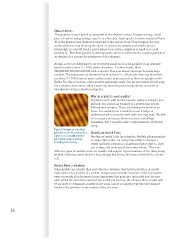
Earth! For this to be true, atoms must be extremely small. Can we see atoms? It’s not easy,
but a modern instrument called a scanning tunneling microscope allows scientists to
visualize the atom, as shown in Figure 1.
Why do scientists need models?
Scientists work with models because reality is complex and
difficult. An atom is an example of a system that is both
difficult and complex. There are many parts inside of an
atom. It is useful to use a model because it helps us
understand what cannot be seen with our own eyes. Models
are necessary in science. However, you must always
remember that a model is only a representation of the real
thing.
Figure 1. Images of individual
gold atoms can be seen on the Models are Useful Tools
surface of a smooth sheet of Models are useful tools for scientists. Models allow scientists
gold metal using scanning to study objects that are nearly impossible to study as a
tunneling microscopy. whole and help scientists to understand these objects. They
can analyze and make predictions about them. There are
different types of models; some are smaller and simpler representations of the thing being
studied. Scientists use models for many things like atoms, the layers of the Earth, and the
cell.
Models Have Limitations
Since models are simpler than real objects or systems, they have limitations. A model
deals with only a portion of a system. It may not predict the behavior of the real system
very accurately. But the more computing power that goes into the model and the care
with which the scientists construct the model can increase the chances that a model will
be accurate. For example, models of the atom cannot accurately represent the distance
between the particles or the motion of the electrons.
16
The graphite in your pencil is composed of the element carbon. Imagine taking a small
piece of carbon and grinding it until it is a fine dust. Each speck of carbon would still have
all of the physical and chemical properties of the carbon atom. Now imagine that you
could somehow keep dividing the speck of carbon into smaller and smaller pieces.
Eventually, you would reach a point where your carbon sample is as small as it could
possibly be. This final particle is called an atom, which is defined as the smallest particle of
an element that retains the properties of that element.
Atoms, as you probably know, are extremely small. In fact, the graphite in an ordinary
pencil contains about 5 × 10²⁰ atoms of carbon. In other words, that’s
500,000,000,000,000,000,000 carbon atoms! This is an almost incomprehensibly large
number. The population of the entire Earth is about 7 × 10⁹ people, meaning that there
are about 7 × 10¹⁰ times as many carbon atoms in your pencil as there are people on the
Earth! For this to be true, atoms must be extremely small. Can we see atoms? It’s not easy,
but a modern instrument called a scanning tunneling microscope allows scientists to
visualize the atom, as shown in Figure 1.
Why do scientists need models?
Scientists work with models because reality is complex and
difficult. An atom is an example of a system that is both
difficult and complex. There are many parts inside of an
atom. It is useful to use a model because it helps us
understand what cannot be seen with our own eyes. Models
are necessary in science. However, you must always
remember that a model is only a representation of the real
thing.
Figure 1. Images of individual
gold atoms can be seen on the Models are Useful Tools
surface of a smooth sheet of Models are useful tools for scientists. Models allow scientists
gold metal using scanning to study objects that are nearly impossible to study as a
tunneling microscopy. whole and help scientists to understand these objects. They
can analyze and make predictions about them. There are
different types of models; some are smaller and simpler representations of the thing being
studied. Scientists use models for many things like atoms, the layers of the Earth, and the
cell.
Models Have Limitations
Since models are simpler than real objects or systems, they have limitations. A model
deals with only a portion of a system. It may not predict the behavior of the real system
very accurately. But the more computing power that goes into the model and the care
with which the scientists construct the model can increase the chances that a model will
be accurate. For example, models of the atom cannot accurately represent the distance
between the particles or the motion of the electrons.
16